s3-firmware
Overview
Manages the private S3 bucket that drives the firmware ZIP processing pipeline. The bucket receives uploaded ZIPs in incoming/, routes them through processing/, and routes final artifacts to processed/ or errors/. S3 event notifications connect the bucket to the two firmware Lambda functions.
CloudFormation Stack
firefly-s3-firmware
Dependencies
Deploy Dependencies
| Workflow | Reason |
|---|---|
| func-s3-firmware-uploaded | Lambda ARN required as SAM parameter |
| func-s3-firmware-deleted | Lambda ARN required as SAM parameter |
Delete Dependencies
None — this workflow has no prerequisites.
Required By
Required By Deploy
| Workflow | Reason |
|---|---|
| func-api-firmware-download-get | Bucket must exist before function can generate pre-signed URLs |
Required By Delete
| Workflow | Reason |
|---|---|
| func-s3-firmware-uploaded | S3 event notification (resource-based policy) must be removed before function can be deleted |
| func-s3-firmware-deleted | S3 event notification (resource-based policy) must be removed before function can be deleted |
Deploy Workflow
Description
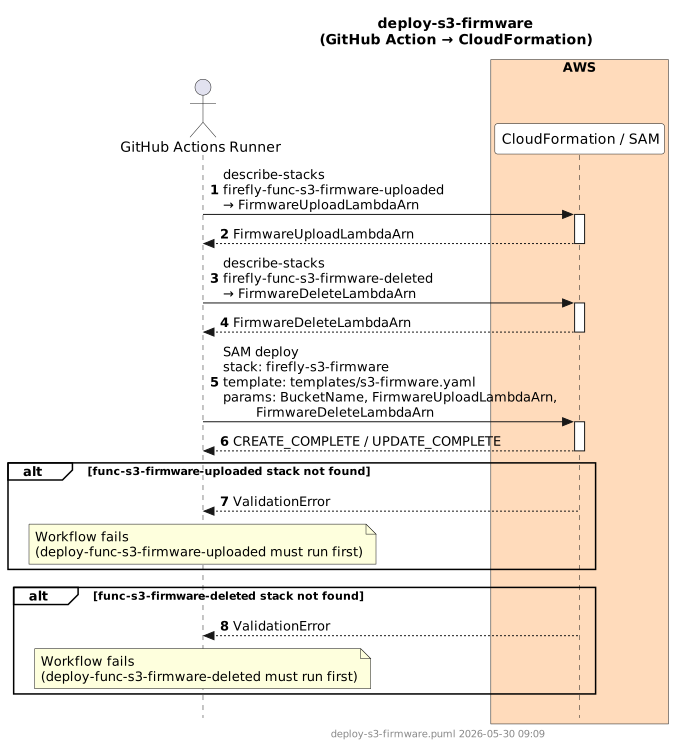
Before deploying, the workflow resolves the ARNs of both S3-triggered Lambda functions by querying their CloudFormation stacks. These ARNs are passed as SAM parameters so CloudFormation can wire the S3 event notifications. The bucket is private with four lifecycle rules to limit storage costs during each pipeline stage.
Steps
- Configure AWS credentials.
- Look up
FirmwareUploadLambdaArnfrom thefirefly-func-s3-firmware-uploadedstack output. - Look up
FirmwareDeleteLambdaArnfrom thefirefly-func-s3-firmware-deletedstack output. - SAM deploy
templates/s3-firmware.yamlwith parameters:BucketName(from secrets)FirmwareUploadLambdaArnFirmwareDeleteLambdaArn
- CloudFormation creates the bucket, S3 event notifications, and lifecycle rules.
Bucket configuration:
- Private (no public access)
- S3 event notification:
incoming/*.zipObjectCreated →func-s3-firmware-uploaded - S3 event notification:
processed/anderrors/ObjectRemoved →func-s3-firmware-deleted - Lifecycle rules: see Firmware Lifecycle
Sequence Diagram
Delete Workflow
Description
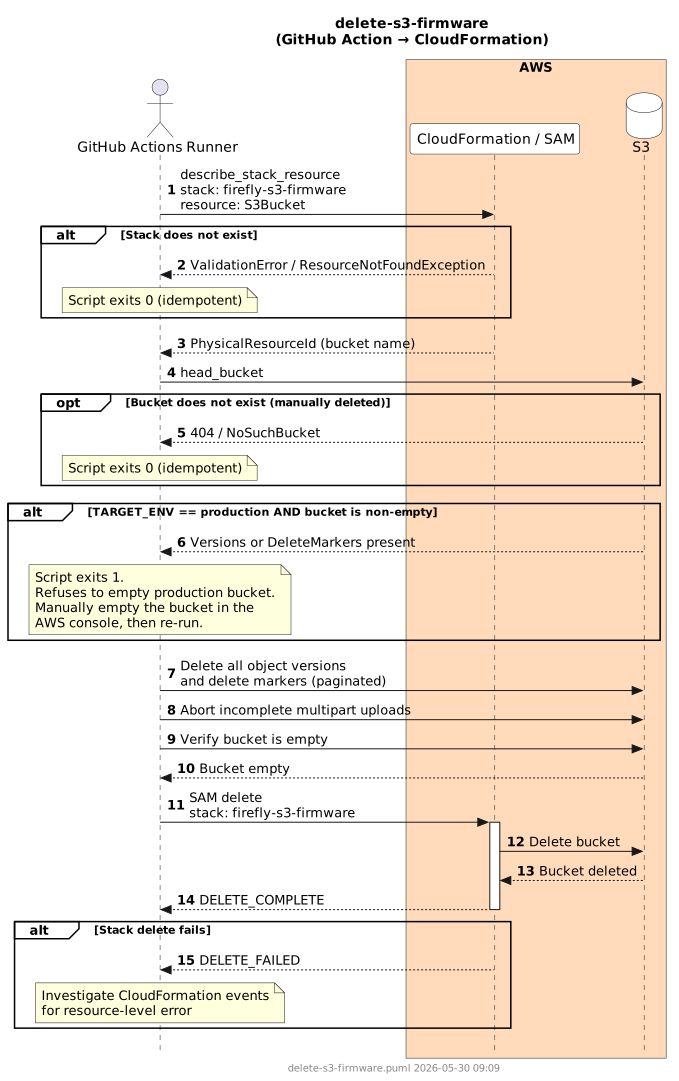
Resolves the bucket name from CloudFormation, empties it, then calls sam delete. The emptying step is idempotent: if the stack does not exist or the bucket was already manually deleted, the step exits cleanly. A production safety guard prevents auto-emptying a non-empty production bucket.
Steps
- Configure AWS credentials.
- Resolve physical bucket name from the
firefly-s3-firmwareCloudFormation stack resource. If the stack does not exist, exit cleanly. - Check that the bucket exists. If it was already manually deleted, exit cleanly.
- Production guard: if
TARGET_ENV == productionand the bucket contains any object versions or delete markers, exit with an error. Manually empty the bucket in the AWS console before re-running. - Delete all object versions and delete markers (paginated).
- Abort any incomplete multipart uploads.
- Verify the bucket is empty.
- SAM delete
firefly-s3-firmware.
Sequence Diagram
Failure Scenarios
| Scenario | Behavior |
|---|---|
| Lambda ARN lookup fails (function stack not deployed) | describe-stacks call returns an error; workflow fails before SAM deploy is attempted. Deploy func-s3-firmware-uploaded and func-s3-firmware-deleted first. |
| Bucket manually deleted before workflow runs | head_bucket returns 404; workflow exits cleanly and proceeds to sam delete, which handles the already-absent bucket resource idempotently. |
| Bucket non-empty at delete time | Workflow deletes all object versions, delete markers, and incomplete multipart uploads before calling sam delete, so CloudFormation never sees a non-empty bucket. |
| Bucket non-empty in production | Production safety guard exits with an error rather than auto-emptying. Manually empty the bucket in the AWS console, then re-run the workflow. |
| S3 event notification already exists | SAM handles idempotently via CloudFormation update; existing notifications are replaced in-place. |